

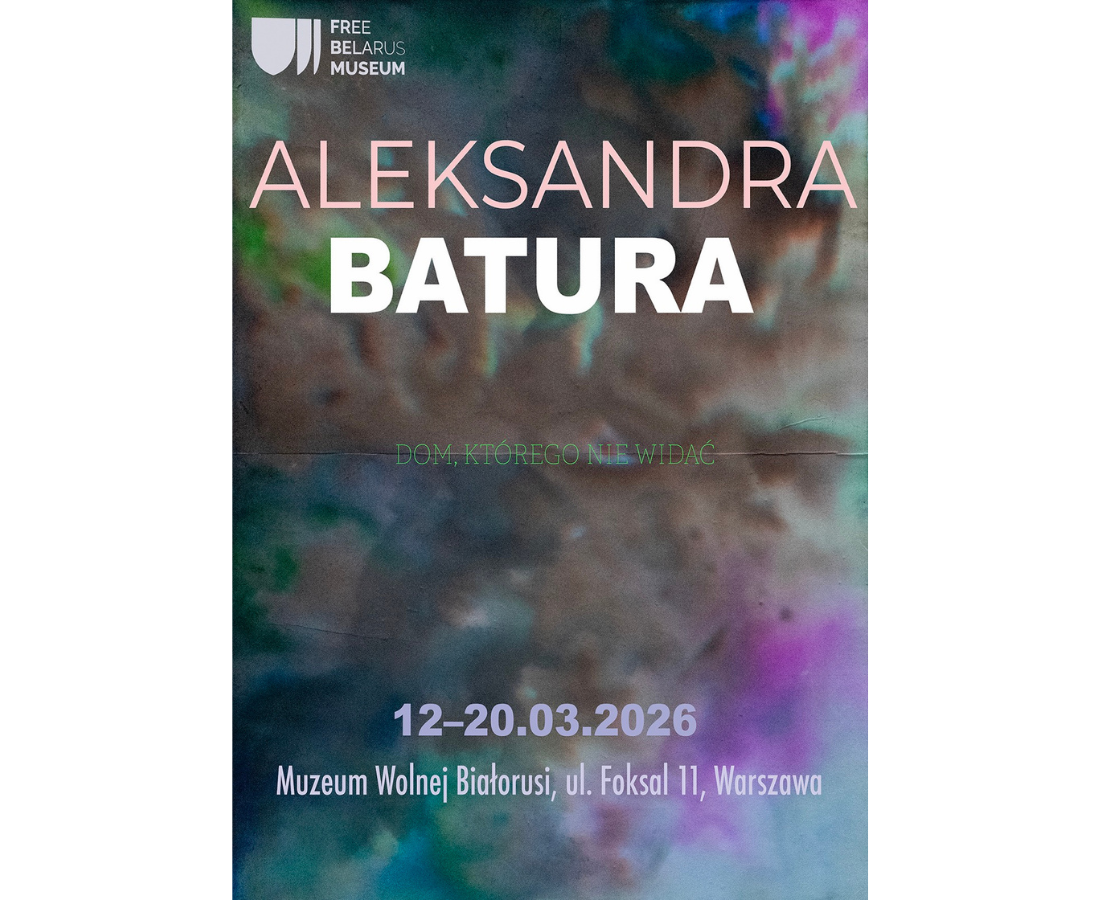
12–20.03.2026
Opening hours:
Tuesday–Friday: 16:00–20:00
Saturday–Sunday: 12:00–20:00
The art exhibition is based on the transformation of emotions, memories, and imaginings connected with the idea of home—both as a physical place and as a state of mind. The artist refers to Warsaw, the city her grandparents came from and where she herself settled, as well as to her roots in the Suwałki region, the borderland of Poland, Lithuania, and Belarus. She reflects on what “home” means for a contemporary person—also in the context of forced migration, uprootedness, and one’s relationship with nature.
The exhibition is accompanied by a sound installation created in collaboration with radio drama producer Piotr Skotnicki. It was composed from sounds recorded in the artist’s Warsaw apartment and in the Brzozowski Palace.
“Home” is important to every person, regardless of beliefs or experiences. It has both a physical and an immaterial dimension. It is filled with feelings, emotions, and memory. It has specific shapes, unique corners and spaces; it also conceals shadows and things not fully understood.
In most homes, change is constant. Something is being built. Something is falling apart.
We carry within us an image of what a home should be. Sometimes we experience a contradiction between our imagination and reality.
Home can be a core—a place where what matters most develops: closeness, acceptance, trust, community. It can also be a wounding emptiness, a sham, a façade, or an arena of struggle. It may be warm, bright, and welcoming—or inaccessible, cold, full of darkness and suffocating secrets. At times it is an aspiration or an unattainable idea, a dream, a longing.
There are people who have no home: the lonely, the rejected, emigrants, refugees…
A human being, too, is a home—for microorganisms, for thoughts and feelings, for one’s children and for oneself.
We dwell not only in language, but also in a gaze—in a unique vision of the world.
〜
Aleksandra Batura was born in 1982 in Augustów, in the Suwałki region of Poland.
She is a visual artist working across a variety of media – from painting and drawing to installation and performance.
She completed her doctoral studies at the Academy of Fine Arts in Kraków. She is a recipient of scholarships from the Polish Ministry of Culture and National Heritage and the Italian Ministry of Foreign Affairs.
She studied at the Faculty of Painting at the Academy of Fine Arts in Gdańsk and Kraków, as well as at the University of Porto (Portugal) and the Accademia di Belle Arti di Macerata (Italy).
She has participated in numerous artistic residencies and symposia.
Her works have been presented in dozens of exhibitions in Poland and abroad.
She is also the author of large-scale murals.


